If your cat seems to spend most of the day asleep, that is because it does. Cats are among the sleepiest domestic animals, and the habit is built into how their bodies and instincts work.
This guide explains how much sleep is normal at each age, why cats sleep the way they do, and the changes in a sleep pattern that actually mean something.
How Many Hours a Day Do Cats Sleep?
Most adult cats sleep between 12 and 16 hours a day, and many push past 16. Kittens and senior cats often reach 18 to 20 hours. A cat asleep for two-thirds of the day is not lazy or sick; it is a normal cat doing exactly what its species does.
What surprises many owners is the pattern rather than the total. Cats are not nocturnal in the strict sense. They are crepuscular, most active around dawn and dusk, which matches when their wild ancestors' prey was moving. The 4 a.m. kitchen zoomies and the mid-afternoon coma are two ends of the same rhythm.
Why Cats Sleep So Much
Three reasons account for most of the sleeping.
Evolution Built a Sprinter
Wild cats hunt in short, explosive bursts: stalk, sprint, pounce, done. That style of hunting is expensive, so the animal's biology is tuned to rest hard between efforts. Your cat's five-minute mad dash through the hallway is the same program, minus the prey. Conserving energy between bursts is not a habit cats picked up; it is the factory setting.
Sleep Serves Growth and Repair
Kittens sleep most of the day partly because growth hormone releases during sleep. Adult cats use deep sleep for tissue repair and memory consolidation, the same maintenance work all mammals do. Senior cats sleep more as their energy budget shrinks with age.
Boredom Fills the Gaps
An indoor cat with nothing to do sleeps more than an engaged one. A cat that wakes only for meals may simply have too little stimulation, which is a different issue than natural sleepiness. If the extra sleep comes with a flat, disinterested cat, more daily play is the fix, not worry. See How to Keep an Indoor Cat Active for practical enrichment ideas.
The Two Kinds of Cat Sleep
Watch a sleeping cat closely and you will notice it is not always deep asleep. Cats cycle between light dozing and true deep sleep, and most of their hours are the light kind.
In light sleep the ears still track sounds, the body stays loosely coiled, and the cat can be fully alert in a second. This is the "sleeping with one eye open" state, and it lets a resting cat monitor its territory without really waking. Deep sleep comes in shorter stretches, often with twitching whiskers, paws, or eyelids as the cat dreams. Both kinds are normal and necessary.
Sleep by Life Stage
Age changes the sleep budget more than almost anything else.
- Kittens may sleep up to 20 hours while their bodies and nervous systems develop. Frequent deep-sleep twitching is normal.
- Adults settle into the 12 to 16 hour range, with individual variation by breed, health, and household activity.
- Seniors drift back toward longer sleep as metabolism slows, often 16 to 18 hours, and may sleep more lightly and in new spots as joints stiffen.
The Cat Age Calculator gives a rough human-age equivalent for your cat's stage, which helps set expectations for how much daytime rest is typical.
When Sleeping a Lot Is a Problem
The sleep total matters less than the change. A cat that has always slept 15 hours is a healthy cat. A cat that suddenly sleeps 18 and stops greeting you at the door is telling you something shifted.
Worth attention: sleeping in unusual places like beside the litter box or in a closet, sleeping through meals, a dull or unkempt coat alongside extra sleep, or lethargy where the cat sleeps deeply and stays groggy when roused. Pain, infection, thyroid problems, and anemia all announce themselves partly through sleep changes. Any of these combined with more sleep earns a vet call.
Frequently Asked Questions
Is it normal for my cat to sleep all day?
Yes, if that has always been the pattern and the cat is alert, eating, and grooming normally when awake. Cats sleeping 12 to 16 hours daily is standard; only a change in the pattern is a flag.
Why is my cat awake all night?
Cats are crepuscular, wired for dawn and dusk activity, and indoor cats often drift nocturnal from boredom. Evening play sessions and a meal before your bedtime help shift the rhythm. See Why Does My Cat Meow at Night? for the nighttime routine.
Do cats dream?
The twitching paws, whiskers, and eyes during deep sleep strongly suggest they do, since cats experience REM sleep like other mammals. A twitching sleeping cat is having a normal dream, not a seizure.
Should I wake my cat if it sleeps too much?
No need to wake a healthy sleeping cat. If you are worried about boredom, add play sessions and enrichment to its waking hours rather than interrupting sleep.
Let Sleeping Cats Lie
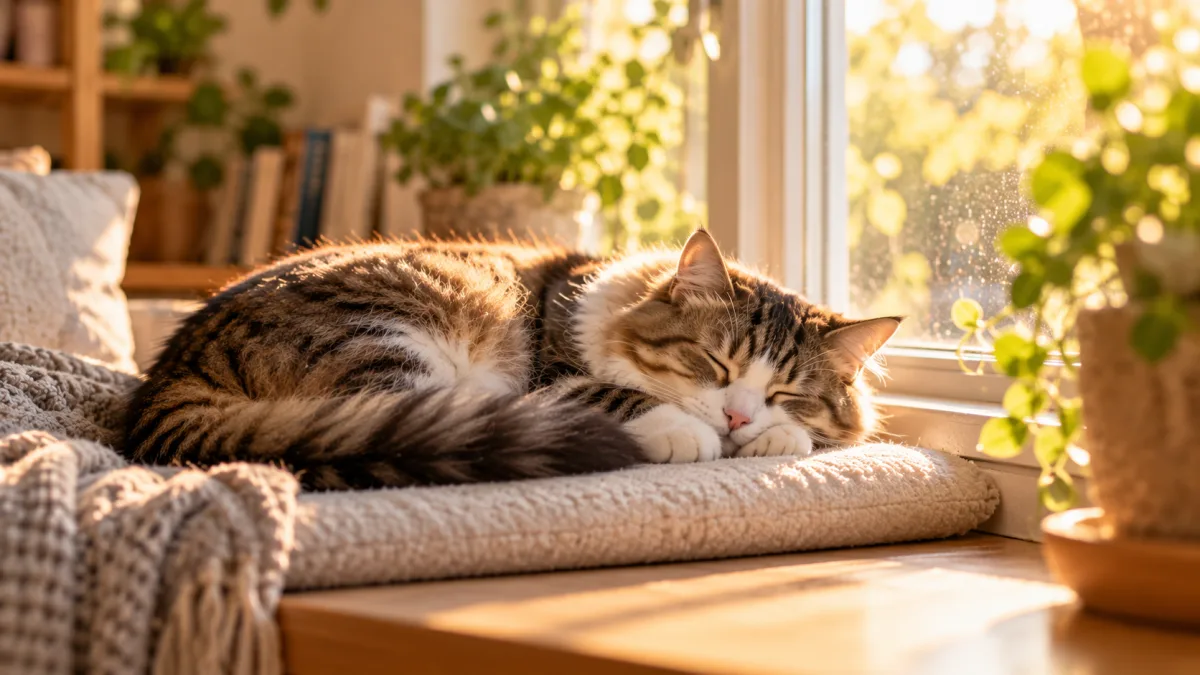
A cat asleep on the couch for most of the afternoon is a success story, not a symptom: an animal evolved to conserve energy, in a home safe enough to allow it. Learn your cat's normal pattern, keep the waking hours enriched, and only the departures from normal need your attention.
For the other half of the sleep picture, see Why Does My Cat Meow at Night?, and browse more in Sleep & Nighttime Activity.